Partial Knee Replacement vs Total Knee Replacement: Which Is Suitable for You?
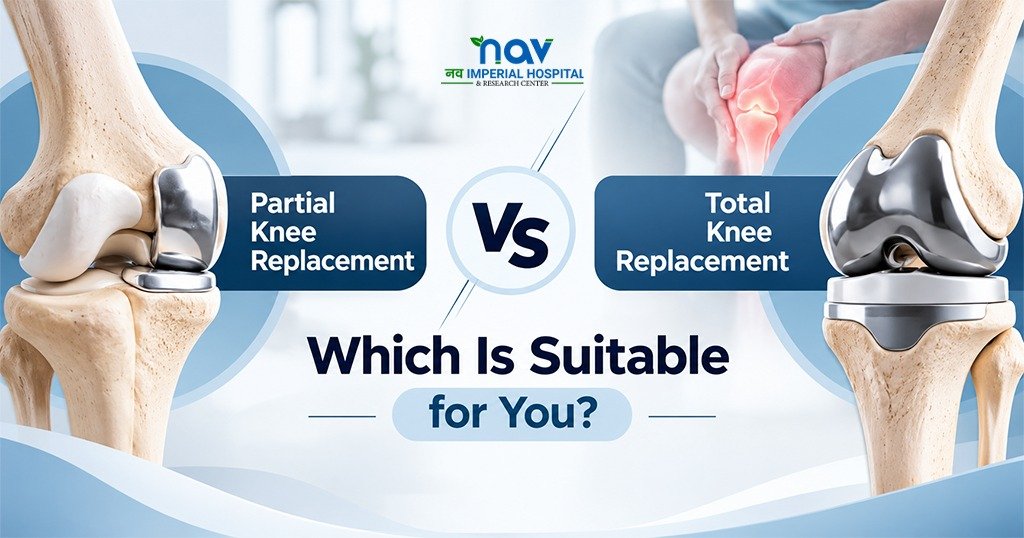
Knee pain does not always start as something serious. One day, you may notice it when climbing stairs, getting up from a chair or walking to the shops. It may not be persistant at first, but over time, everyday movements can become harder. Osteoarthritis is one possible reason, as the cartilage inside the knee wears down gradually.
When medicines, physiotherapy and other treatments no longer bring enough relief, a doctor can suggest knee replacement. So, there are two main options: partial knee replacement vs total knee replacement. The choice depends on how much of the knee joint has been damaged. Now, let us see what sets them apart, and how doctors decide which option may suit you.
What Is Partial Knee Replacement?
It may be an option when arthritis affects only one part of the knee.
How Partial Knee Replacement Works
Also called unicompartmental knee replacement, this procedure replaces only the damaged section of the knee rather than the entire joint. The knee has three compartments, and the operation may be considered when just one is affected.
-
The damaged joint surface is replaced with artificial components.
-
Healthy bone and cartilage in the unaffected compartments are preserved where possible.
-
Ligaments that support knee movement may also be retained if they are suitable.
Who May Be Suitable for Partial Knee Replacement?
This procedure is generally for people whose joint damage is limited and whose knee can still function with adequate stability. Age on its own does not determine knee replacement eligibility.
-
Arthritis or cartilage damage is confined to one compartment.
-
The knee has suitable ligament function and alignment.
-
Examination and imaging support the use of a partial replacement.
The final decision depends on the surgeon’s assessment of the knee and the patient’s overall health.
What Is Total Knee Replacement?
Sometimes the damage in a knee goes beyond one small area. When arthritis has affected several parts of the joint, a partial replacement may not be enough. The surgeon may then recommend total knee replacement surgery.
How Total Knee Replacement Works
The operation involves removing the worn cartilage and preparing the damaged bone surfaces to receive artificial parts. These replace the damaged surfaces of the knee joint.
-
Unlike partial replacement, the procedure covers the damaged surfaces across the knee.
-
The worn surfaces are replaced with artificial components. This helps the joint move without the damaged cartilage rubbing against other surfaces.
-
Everyday movement may become easier. The aim is to reduce pain and help with activities such as walking and standing.
-
It can address more widespread arthritis. Doctors may recommend it when damage affects several compartments of the knee.
Who May Be Suitable for Total Knee Replacement?
A surgeon may consider this procedure when knee problems continue to interfere with daily life and other treatments have not provided enough relief. Suitability depends on the extent of damage and the patient’s overall health.
-
People with extensive knee osteoarthritis.
-
Those whose pain and stiffness make walking, climbing stairs or standing difficult.
-
Patients with widespread joint damage or knee deformity, when surgery is clinically appropriate.
-
People who have not gained sufficient relief from recommended non-surgical treatments, such as physiotherapy or medication.
In such circumstances, an orthopaedic surgeon can assess the knee and review imaging before asking you to undergo a procedure.
Partial Knee Replacement vs Total Knee Replacement: Key Differences
The main difference between partial and total knee replacement is how much of the knee joint needs replacing, which also affects who may be suitable for each procedure.
|
Comparison Factor |
Partial Knee Replacement |
Total Knee Replacement |
|
Extent of replacement |
Only one damaged compartment is replaced. |
Damaged joint surfaces across the knee are replaced. |
|
Typical suitability |
Usually considered when arthritis is limited to one compartment. |
May be recommended when damage affects several compartments. |
|
Preservation of healthy structures |
More of the healthy bone, cartilage and supporting structures may be preserved. |
More of the joint surface is replaced. |
|
Surgical approach |
The approach depends on the patient’s anatomy and the planned procedure. |
The approach is decided based on the patient’s anatomy and the planned procedure. |
|
Recovery |
Some suitable patients may recover more quickly in the early stages. |
Rehabilitation may take longer, depending on the individual. |
|
Rehabilitation |
Physiotherapy is entirely based on the patient’s progress and needs. |
Physiotherapy is generally tailored to the individual’s progress and needs. |
|
Potential risks |
Risks include infection, blood clots, stiffness and implant-related problems. |
Risks could be associated to infection, blood clots, stiffness and implant-related concerns. |
|
Revision surgery |
Further surgery may be needed, including conversion to total knee replacement. |
Revision surgery may be needed if the implant fails or complications develop. |
Neither procedure is better than the other. Recovery and results vary from person to person, and the decision depends on the location and extent of joint damage, knee stability and the surgeon’s assessment.
Benefits and Limitations of Partial Knee Replacement
Partial knee replacement surgery may be an option when arthritis is confined to one part of the knee. Whether it is suitable depends on the condition of the joint.
Potential Benefits
-
Partial replacement leaves the unaffected compartments of the knee in place, preserving more of the original joint.
-
Because the surgery involves a smaller area, it may cause less disruption to surrounding tissues in suitable patients.
-
Some patients regain mobility sooner and find that their knee feels more natural compared with a total replacement.
Limitations
-
The procedure is not suitable when arthritis or cartilage damage affects several compartments of the knee.
-
Arthritis can develop in other parts of the joint that were not replaced during surgery.
-
If further damage occurs or the implant develops problems, another operation may be needed. This can include converting the partial replacement to a total knee replacement surgery in Jaipur or other places.
Benefits and Limitations of Total Knee Replacement
When arthritis has spread through much of the knee, replacing only one part may not be enough. A total knee replacement allows the surgeon to treat the damaged surfaces across the joint.
Potential Benefits
-
Helps with widespread arthritis- The operation addresses damage across the knee, rather than just one compartment.
-
Can ease long-standing pain- For people who are suitable for surgery, replacing the worn joint surfaces may make walking, standing and climbing stairs less painful.
-
Make daily movement easier- A person whose knee stiffness has started to interfere with routine activities may find it easier to move after surgery and rehabilitation.
Limitations
-
Major Portions of Joint Operated- Compared with partial replacement, the surgeon works on a relatively larger area of the knee surface.
-
Recovery takes work and patience: Physiotherapy helps rebuild strength and movement. Progress is different for everyone, and follow-up visits remain important.
-
Complications are possible: Infection, blood clots, stiffness and implant problems can occur. Before surgery, ask your surgeon about these risks and how long the replacement may last.
How Do Doctors Decide Which Knee Replacement Is Right for You?
There is no particular test that tells a surgeon which knee replacement is actually required. That decision is solely based on what has happened to your knee, how much it impacts your daily life and whether surgery will help.
-
If arthritis is restricted to one compartment, a partial replacement might be possible. Damage that has happened across several compartments can point towards an entire replacement.
-
Your doctor can request imaging through X-rays to check the joint and look for changes in the bone.
-
Ligament damage and problems with alignment can affect which procedure is more suitable.
-
Your symptoms, such as pain while walking, stiffness after sitting or difficulty while using the stairs, indicate to the surgeon how much the knee affects your routine.
-
Previous treatment that you have received is also relevant. The doctor will ask whether physiotherapy, medication or other non-surgical options have helped.
-
Other medical conditions and your expectations for recovery also have to be considered; general health cannot be overlooked.
If you are weighing up your options, consulting the best knee doctor in Jaipur can assist in understanding the findings and discussing which procedure might suit your needs more.
Recovery After Partial vs Total Knee Replacement
Knee replacement recovery varies from one person to another. The type of surgery is essential, but your general health, mobility before the operation and progress after surgery also have a role to play.
Early Recovery
After partial knee replacement, patients may be helped out of bed and encouraged to walk with support once their care team gives the go-ahead. Since the operation affects only one part of the knee, some people find it easier to get moving again in the early days. Pain control and wound care remain important.
After a total knee replacement, patients usually start walking with support once their doctor or physiotherapist says it is safe. The knee can feel stiff, sore and swollen in the beginning. So, getting around may take some effort.
The care team helps manage the pain and checks the wound and mobility before deciding when the patient can go home. That decision also depends on their general health and whether they have enough support at home.
Physiotherapy and Returning to Daily Activities
After a partial knee replacement, exercises generally get the knee moving again and strengthen the muscles around it. After some time, walking and everyday tasks will follow, depending on how the knee feels and how recovery is going.
Following a total knee replacement, physiotherapy is also centred around bending and straightening the knee, building leg strength and walking with better stability. Some people need more help at first than others.
Your physiotherapist will adjust the exercises as you improve. Do not rush to do more than you have been advised. Moreover, guidance on exercises after total knee replacement can be provided by the care team.
What Is the Cost Difference Between Partial and Total Knee Replacement?
The cost of knee replacement is determined by the type of implant, hospital stay, diagnostic tests, medicines and physiotherapy. Contrary to a common misconception, partial knee replacement is not always cheaper than total replacement. The total expense is based on the patient’s condition, the treatment plan and any additional care required during recovery.
If you are comparing options for low-cost knee replacement surgery, ask the hospital for a written estimate before you make a decision. Go through what it covers, such as the surgeon’s fees, implant, hospital charges and rehabilitation. Do not forget to ask whether complications or extra hospital days can result in additional costs.
When Should You Consult a Knee Specialist?
Do not ignore stiffness or swelling that makes it difficult to bend or straighten your knee. You must visit a doctor if you experience any of the following-
-
Pain that affects walking, sleep or routine tasks.
-
Stiffness or swelling that does not seem to go away.
-
Difficulty moving around. Despite physiotherapy, medication or other recommended treatment, you do not seem to heal.
However, you must not assume that these symptoms always require surgery. A knee specialist in Jaipur can examine your knee, review imaging if necessary and discuss appropriate treatment options according to the extent of joint damage.
Conclusion
All damaged knees do not need the same operation. When arthritis affects one part of the joint, a partial knee replacement may be an option. If the damage has spread further, a total replacement may be more suitable. The decision needs to come from an assessment of the knee, not simply the patient’s age or the cost of surgery. If ongoing knee pain is making it hard to walk or manage daily tasks, speak with an orthopaedic specialist at NAV Imperial Hospital, Jaipur.
Frequently Asked Questions
1. Is partial knee replacement better than total knee replacement?
Neither is always better. A partial replacement can suit damage limited to one compartment; a total replacement might be needed when arthritis affects a major portion of the knee.
2. Does partial knee replacement have a faster recovery?
Some patients regain mobility sooner after partial replacement. Even then, recovery is dependent on overall health, knee condition and progress with physiotherapy.
3. Can partial knee replacement later become total knee replacement?
Yes. If arthritis spreads to other parts of the knee or implant problems develop, further surgery might be needed to replace the remaining joint surfaces.
4. How long does a knee replacement implant last?
There is no particular lifespan for every implant. Generally, 90% or more of hip or knee replacements tend to last for at least 10 to 15 years.
5. Can both procedures relieve knee arthritis pain?
Yes, both procedures can ease arthritis pain and improve movement when recommended for the right reasons. Results vary, and neither operation guarantees complete pain relief.
6. How do I know which knee replacement procedure I need?
An orthopaedic surgeon can assess your symptoms, examine the knee and review X-rays or other imaging when needed before recommending a suitable procedure.