7 Signs You Need Knee Surgery – Don’t Ignore These Symptoms
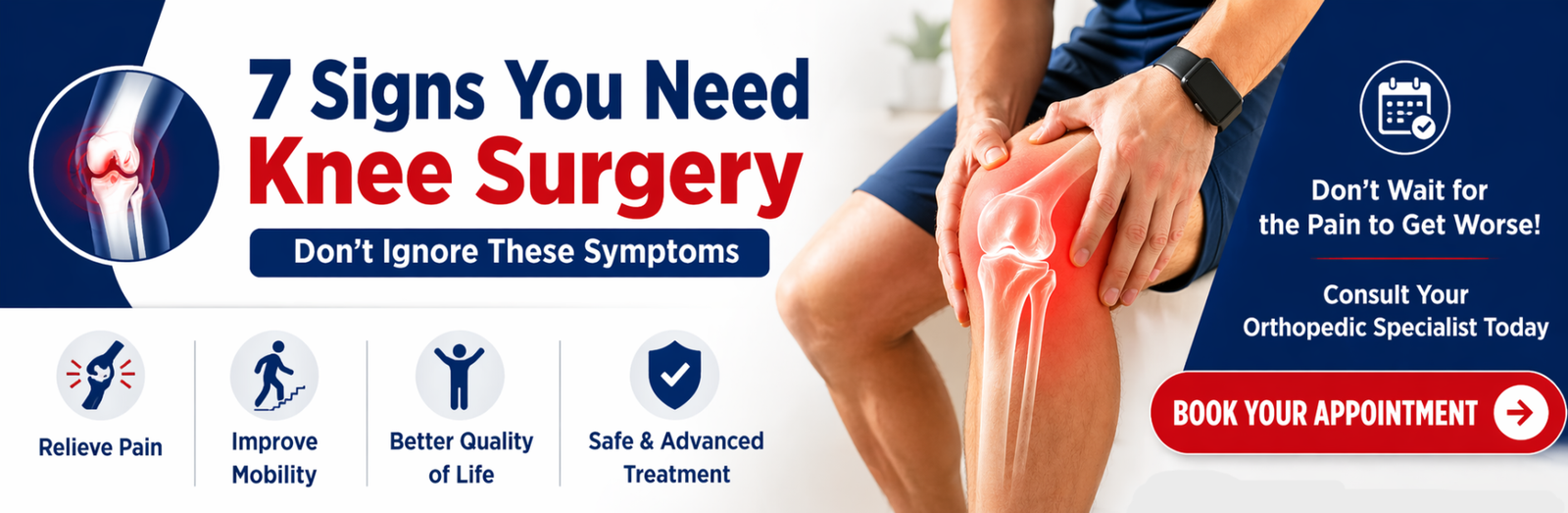
The actual joints in your lifestyle are your knees. They support the weight and the movement of your body, whether it be in climbing the stairs or taking a morning walk. However, when discomfort turns into a constant companion, it might be more than just "old age" or "overexertion." This is because chronic knee problems can cause irreversible damage to your joints and result in a drastic change in the quality of life.
When it comes to regaining mobility, often the first step can be finding the Best Orthopedic Surgeon in Jaipur. In case you have been experiencing chronic pain, the red flags can guide you to know when to stop using temporary remedies and resort to permanent remedies such as Knee Surgery in Jaipur.
1. Persistent Knee Pain That Won’t Go Away
Your body sends you signals in the form of pain. Although a slight stressor can be resolved through rest, when the painful experience persists over several weeks or months, it is a big warning sign. When you have pains in your knee when you are still resting or even attempting to sleep, that means that the joint structure, either the cartilage, ligaments or the bone is highly impaired. The conservative treatments probably have reached their limit when the pain has become a back-sound in your life.
2. Difficulty in Walking or Standing
Knee mobility is the major role of the knee. When you are starting to plan your day on how much time you will be walking or you are avoiding socializing events because standing up half an hour seems like a marathon, then you are at risk of compromising the health of your joints. The inability to walk on uneven surfaces or a "limp" that has become your new reality are definite signs that the mechanical integrity of the knee is not doing well.
3. Swelling and Stiffness in the Knee
Internal agony is indicated by chronic inflammation. Although some degree of swelling following a rigorous hike is normal, the presence of an effusion (that is, a fluid around the knee) that cannot be attributed to a particular injury is often a sign of osteoarthritis or rheumatoid arthritis. When your knee is tight or stiff, especially in the morning or after sitting long, then the lubricating synovial liquid, or the cartilage can be damaged.
4. Knee Deformity or Visible Changes
Look in the mirror, your knees. Are they bow-legged or do they bow in (knock-knees)? The fact that the position of one side of your legs has changed visibly indicates that the cartilage on one side of the joint is nearly worn out, and the bones are tilted. This malalignment is like a vicious circle, which exerts even greater stress on the damaged region and increases the necessity to have Knee Surgery in Jaipur.
5. No Relief from Medications or Therapy
The majority of orthopedic treatments start with RICE (Rest, Ice, Compression, Elevation), anti-inflammatory drugs, and physiotherapy. These are very good in cases of initial problems. But when these have been tried to the uttermost, and the pain has not diminished, you have come to a plateau. Surgical intervention is the most practical option when Cortisone injections or physical therapy is no longer able to give a window of relief and lead to a pain free life.
6. Locking or Instability in the Knee
Do you ever suddenly have your knee give out? Or perhaps it "locks" in one position, making it impossible to straighten or bend your leg without a painful "pop"? This may be a sign of mechanical blockage, e.g. a torn meniscus or a fragment of bone or cartilage floating in the joint space. The instability is not safe, as it may cause falls and secondary injuries.
7. Severe Pain During Daily Activities
Let the easiest activities such as putting on socks, stepping out of a vehicle, or going to the post office become Herculean, and your independence is in question. When you are always seeking a chair or have to use handrails extensively, the psychological and physical cost is too great. Surgery is not merely about repairing a bone, it is about regaining your capability to live without having to constantly count pain.
When Should You Consider Knee Surgery?
Making a decision about surgery is a joint effort between you and the Best Orthopedic Surgeon in Jaipur. In the majority of cases, surgery is taken when:
- Non-surgery (PT, weight loss, meds) does not help.
- The pain interferes with your sleep and mental well-being.
- Advanced imaging (MRI/X-ray) would reveal considerable bone-on-bone contact.
- You can no longer work or keep your home.
Types of Knee Surgeries
In modern medicine, there are different degrees of intervention, depending on the degree of damage.
1. Arthroscopy
This is a least invasive surgery involving a surgeon using small openings to place a camera (arthroscope). It is usually employed to mend ripped ligaments (such as the ACL), excise a ruptured meniscus, or eliminate free bone fragments.
2. Partial Knee Replacement
In case the injury is limited to a single "compartment" of the knee, a partial replacement can be done. This keeps the healthy bone and ligaments intact in the rest of the knee resulting in quicker healing and a more natural sensation.
3. Total Knee Replacement (TKR)
A TKR is the gold standard in the case of advanced arthritis and the entire joint is worn out. The surgeon excises the damaged areas of the femur and tibia, and substitutes them with high-grade metal and plastic materials.
Benefits of Knee Surgery
Knee Surgery in Jaipur is mainly aimed at restoring the functionality. Patients often report:
- Great pain relief: The majority of patients report a 90% or better decrease in chronic pain.
- Better Mobility: Can walk, swim and even bike once again.
- Improved fit: Correction of deformities such as bowing.
- Improved Quality of Life: Being able to resume hobbies and social activities without experiencing pain.
Recovery and Aftercare
Surgery is half of the battle; the other half is recuperation.
- Physical Therapy: Starting almost immediately after surgery, PT is crucial for regaining strength and range of motion.
- Home Modification: Raised toilet seats and elimination of rug hazards in the initial few weeks.
- It is consistent: Adherence to the treatment of the surgeon in terms of medications and exercises to avoid blood clots and stiffness.
Don’t Ignore the Warning Signs of Knee Damage
The foe of orthopedics is procrastination. The later you are the more your muscles get atrophic and the other joints (such as the opposite knee or lower back) become overcompensated and hurt. It is advisable to talk to a professional who can help you understand whether you should change your way of life or undergo surgery.
FAQs
1. How do I know if I really need knee surgery?
When you continue to experience pain when at rest, and when your daily activities are limited, and your pain does not respond to medication and therapy, you want to see the Best Orthopedic Surgeon in Jaipur to have a thorough assessment and X-rays.
2. Is knee surgery safe?
One of the most successful and widespread operations in the contemporary medicine is knee replacement. Although there are risks involved in all surgeries (such as infection or clots), the risk of complications is low, particularly where the surgeon is experienced and working in a clean and modern surgical facility.
3. How long does it take to recover from knee surgery?
The vast majority of patients will be able to walk with assistance in 24 hours. Complete healing, during which you can resume most of the vigorous activities, typically requires 3 to 6 months, with your commitment to physical therapy.
4. Can I avoid knee surgery?
Early intervention with weight loss, quadriceps strengthening and bracing can postpone surgery. But when cartilage is absent (bone-on-bone) surgery is most commonly the sole means of obtaining a lasting relief.
5. What is the success rate of knee replacement surgery?
The success rate is very high. More than 90 percent of patients who receive a total knee replacement report a major decrease in pain and a tremendous increase in the capability to carry out ordinary activities of everyday living.