Robotic Knee Replacement vs Traditional: Complete Guide (2026)
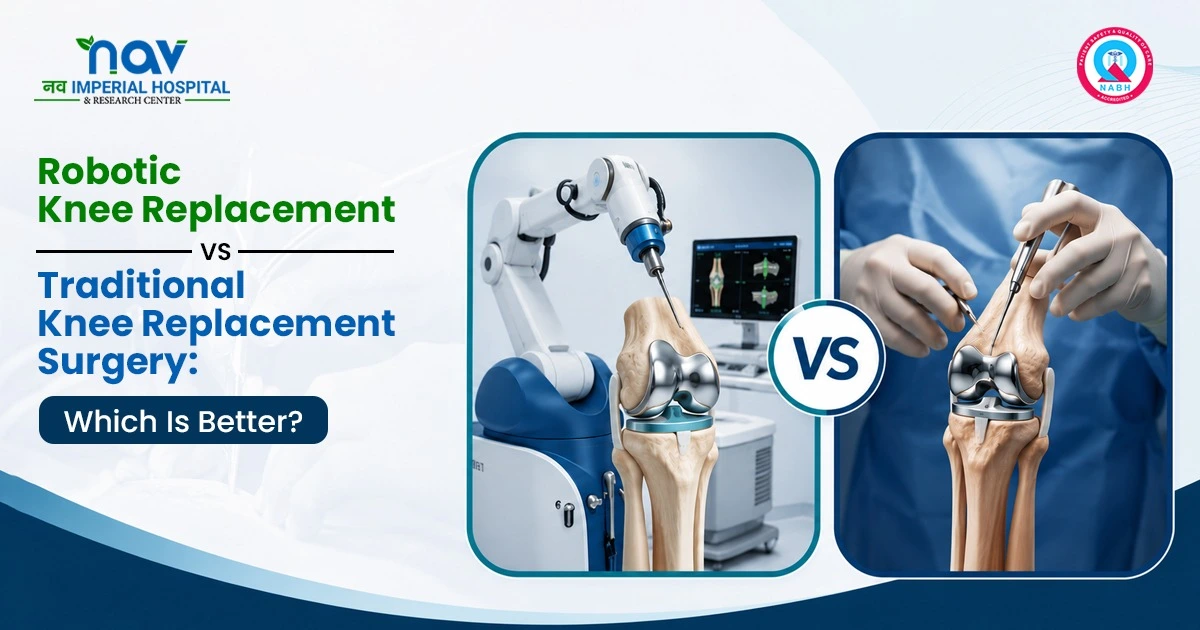
Knee arthritis is one of the biggest causes of long-term disability in India, and Jaipur is no exception. Robotic knee replacement vs traditional knee replacement is usually the first question patients ask once painkillers and physiotherapy stop working in an effective manner, and it's a fair question. The two approaches don't just differ in name; they differ in how the surgery gets planned, how precise the cuts are, and how quickly a patient gets back to leading a normal life.
A lot of people put off surgery for years. Not because they distrust the procedure, but because they do not have clarity regarding which version is right for their knee. Robotic-assisted systems are the newer addition, while traditional surgery has been the preferred option for decades.
Both carry strong success rates in the hands of an experienced surgeon, so this isn't really a story of "old vs new"; it's about matching the right method to the right patient. That's a conversation worth having with your orthopedic doctor in Jaipur before anything is decided.
Robotic knee replacement surgery offers greater precision, personalized surgical planning, improved implant positioning, and potentially faster recovery compared to traditional knee replacement surgery. However, the best option depends on factors such as the patient's knee condition, overall health, bone quality, and the orthopedic surgeon's recommendation.
Robotic Knee Replacement vs Traditional Knee Replacement: Key Differences
Here's the side-by-side most surgeons use to explain the two options during a first consultation.
| Feature | Robotic Surgery | Traditional Surgery |
|---|---|---|
| Surgical Precision | Excellent | High |
| Implant Positioning | Highly Accurate | Manual |
| Bone Preservation | Better | Standard |
| Personalized Planning | Yes | Limited |
| Soft Tissue Protection | Better | Standard |
| Blood Loss | Often Less | Slightly Higher |
| Recovery | Potentially Faster | Standard |
| Hospital Stay | Shorter | Standard |
| Pain After Surgery | May Be Less | Moderate |
| Implant Longevity | Potentially Better | Excellent |
What Is Knee Replacement Surgery?
At its core, knee replacement surgery takes out damaged cartilage and bone and swaps them for an artificial implant. The simple goal is to reduce the pain and bring the movement back once medicine and physiotherapy have stopped being effective. Robotic or traditional, the goal is the same. Only the process changes.
Who Needs Knee Replacement?
Surgery isn't the first answer for every ache in the knee. But a few conditions tend to push things in that direction once other treatments stop working:
- Osteoarthritis that's worn the cartilage down over the years.
- Rheumatoid arthritis that's changed the joint structure.
- Knee deformity that throws off alignment and gait.
- Severe cartilage damage from an old injury or plain wear.
- Conservative treatment that's already been tried and hasn't helped.
Types of Knee Replacement
Depending on how much of the knee is actually damaged, surgeons pick from three broad options:
- Partial Knee Replacement: For damage limited to one part of the knee
- Total Knee Replacement Jaipur: For damage across the whole joint surface
- Revision Knee Replacement: For correcting or replacing an older implant
What Is Traditional Knee Replacement Surgery?
Traditional knee replacement focuses on manual bone preparation and standard surgical instruments. The surgeon measures, cuts, and fits the implant using training, experience, and a steady hand rather than computer-guided input.
It has positives like decades of proven use. It's widely available, and the long-term data backing it is extensive. But it's not without its trade-offs. Outcomes rest heavily on the surgeon's manual precision; implant positioning can shift slightly from case to case, and recovery isn't always as predictable as patients might hope.
What Is Robotic Knee Replacement Surgery?
Robotic knee surgery in Jaipur builds on the same operation but adds a layer of digital planning around it. Before the surgeon even picks up an instrument, 3D imaging maps the knee in detail. That data feeds into digital surgical planning, which calculates where the implant should be. During the operation itself, real-time guidance supports precision-assisted bone cuts and implant placement tailored to that specific patient's anatomy.
One thing worth mentioning, since patients get this wrong often: the surgeon still performs the surgery. The robotic system assists with planning and accuracy. It doesn't operate on its own.
Which Surgery Offers Better Accuracy?
This is where the two techniques really differ, and it's usually the first thing patients want to know.
Role of Robotic Technology
Before any incision, the robotic system builds a 3D model of the knee, letting the surgeon plan cuts and implant angles using actual data instead of estimation alone.
Importance of Implant Alignment
Alignment decides how evenly the weight falls across the new joint afterward. Get it wrong, even slightly, and you risk uneven wear, ongoing discomfort, or an implant that doesn't last as long as it should.
Why Accuracy Matters
A few degrees off can change how naturally the knee moves once it's healed. Both methods aim for accuracy; robotic assistance just tends to narrow the margin further.
Benefits of Robotic Knee Replacement
Anyone looking into robotic joint replacement usually wants to know what actually changes for them, day to day. A handful of benefits come up consistently in clinical experience.
Improved Precision
Digital mapping takes some of the guesswork out of positioning.
Smaller Bone Cuts
Guided cuts tend to be more conservative and targeted.
Better Implant Alignment
Planning adjusts to each patient's own bone structure, not a generic template.
Reduced Pain
Better soft tissue protection often means less discomfort right after surgery.
Faster Recovery
Many patients are fit and get back to normal life sooner, though this still depends on individual health.
Higher Patient Satisfaction
Several studies point to stronger satisfaction scores among robotic surgery patients, mostly tied back to alignment accuracy.
Advantages of Traditional Knee Replacement Surgery
Traditional surgery isn't just the fallback option, and it holds up well on its own merits. It's proven across decades of use. It's cost-effective for patients weighing their budget. It suits a wide range of knee conditions, and the outcomes, by now, are reliable and well documented.
Recovery Timeline Comparison
Recovery speed comes up in nearly every consultation. Here's a general sense of how the two compare, though healing always depends on age, overall health, and how consistently physiotherapy is followed.
| Recovery Stage | Robotic Surgery | Traditional Surgery |
|---|---|---|
| Walking | Within 1-2 days | Within 2-3 days |
| Climbing Stairs | Within 3-5 days | Within 5-7 days |
| Driving | 3-4 weeks | 4-6 weeks |
| Daily Activities | 4-6 weeks | 6-8 weeks |
| Physiotherapy | 4-6 weeks structured program | 6-8 weeks structured program |
| Full Recovery | 3-4 months | 4-6 months |
Which Surgery Is Less Painful?
Pain after surgery isn't determined by the technique alone; several things align together. Pain management today is good regardless of which method is used, but soft tissue preservation in robotic procedures can ease that first stretch of discomfort. Patients who get moving early tend to recover more smoothly, and robotic surgery often allows that a little sooner. Still, consistent physiotherapy usually matters more than the surgical tool itself when it comes to how fast pain actually fades.
Who Is a Good Candidate for Robotic Knee Replacement?
Robotic surgery tends to suit patients dealing with severe arthritis that needs precise correction, an active lifestyle where implant alignment really matters long-term, bone quality healthy enough for detailed 3D mapping, and cases where exact alignment is needed due to an old deformity or injury.
Who May Benefit from Traditional Knee Replacement?
Traditional surgery remains the right call for plenty of patients, too, particularly those with complex anatomy that needs a surgeon's judgment more than rigid digital mapping, limited access to robotic systems, depending on the hospital, a surgeon's direct recommendation based on their case history, or simply budget, since traditional procedures usually cost less.
Robotic Knee Replacement Cost in Jaipur
There's no single number; cost shifts based on several things specific to each patient's plan. Rather than quoting fixed figures, it's more useful to understand what actually drives the final bill.
| Factor | Impact on Cost |
|---|---|
| Implant Type | High |
| Hospital Facilities | Moderate |
| Robotic Technology | Moderate |
| Room Category | Moderate |
| Diagnostic Tests | Low |
| Physiotherapy | Moderate |
Risks and Complications
No surgery comes without risk, and knee replacement is no exception, regardless of the technique used.
Risks Common to Both Procedures
- Infection at the surgical site
- Blood clots in the leg or lungs
- Implant loosening over time
- Stiffness that limits full movement
- Nerve injury, though this is rare
How Risks Can Be Minimized
A thorough pre-surgical evaluation, an experienced surgical team, sterile operating conditions, and disciplined physiotherapy afterward all cut these risks down considerably. Patients who stick to their rehab schedule tend to run into fewer complications overall.
Success Rate of Robotic vs Traditional Knee Replacement
Traditional knee replacement has decades of long-term data behind it, and implant survival rates commonly stay above 90% at the fifteen-year mark. Robotic knee replacement, being the newer option, hasn't built up quite the same length of track record, but early studies show comparable or even improved positioning accuracy, something researchers connect to better implant survival down the line. Patient satisfaction stays high across both, though there can be a modest edge for robotic procedures, mainly linked to alignment precision.
Questions to Ask Your Orthopedic Surgeon Before Surgery
Worth bringing these into your consultation:
- Am I a candidate for robotic surgery?
- Which implant suits my condition?
- What's my likely recovery timeline?
- What complications should I know about going in?
- How much physiotherapy will this actually require?
Why Choose Nav Imperial Hospital for Knee Replacement Surgery in Jaipur?
Picking the best orthopedic hospital in Jaipur matters just as much as picking the right technique. You could have the best surgical approach in the world, but if the team behind it, the equipment, or the rehab support isn't up to par, recovery suffers anyway. That's really what this section comes down to: covering why Nav Imperial Hospital is the right choice for anyone considering a knee replacement surgery in Jaipur.
Experienced Joint Replacement Surgeons
A surgeon who's handled hundreds of knees, both robotic and traditional, brings a kind of judgment that no amount of technology can replace on its own. Experience at Nav Imperial Hospital shows up in the small decisions made mid-surgery, not just the plan drawn up beforehand.
Advanced Robotic Technology
Having robotic systems available doesn't mean every patient needs them. It means the option exists when it's genuinely the right fit for someone whose anatomy or alignment calls for that extra layer of precision. Not every knee needs it, but it should be there for the ones that do.
Comprehensive Diagnostic Imaging
Good surgery starts well before the operating theatre. Detailed imaging beforehand, X-rays, and MRIs give our surgical team an accurate picture of what they're actually working with. Skip this step, or rush it, and even the best surgeon is planning without complete data.
Personalized Rehabilitation Programs
No two knees heal the same way, so handing every patient the same generic physiotherapy sheet doesn't work. Programs here get shaped around age, fitness level, occupation, and how the surgery itself went. Someone returning to an active lifestyle needs a different rehab pace than someone mainly looking to walk comfortably again.
Multidisciplinary Orthopedic Care
Knee replacement isn't just the job of an orthopedic surgeon in Jaipur in isolation. Our anesthesia teams, physiotherapists, and the broader orthopedic department all share the same vision. When that coordination is missing, patients feel it in delayed pain management, inconsistent advice, or gaps in follow-up care.
Modern Operating Theatres
Facilities matter more than people usually assume. Operating theatres here are equipped to handle both conventional surgery and robotic-assisted procedures without compromise, which means the choice of technique isn't limited by what the hospital happens to have on hand.
Patient-Centered Treatment
At the end of it, knee arthritis treatment plans are built around the actual patient in front of the surgeon, their knee, their lifestyle, their concerns, rather than a standard protocol applied the same way to everyone who walks through the door. That's a small distinction on paper, but it tends to show up clearly in how satisfied patients are with their outcome.
Regain Pain-Free Movement with Advanced Knee Replacement Surgery
If chronic knee pain has started affecting your daily life, it's worth talking to the orthopedic specialists at Nav Imperial Hospital. Our team will assess your condition and tell you plainly whether robotic or traditional knee replacement surgery in Jaipur makes more sense for you.
Conclusion
Robotic and traditional knee replacement specialists in Jaipur are aiming to get a knee that moves without hurting. What separates them is planning precision, how accurately the implant is placed, and how quickly recovery moves, not whether one "works" and the other doesn't. Patients with complex anatomy, tighter budgets, or fairly simple arthritis often do just as well with the traditional route. Those needing precise correction, or heading back into an active lifestyle, might go for robotic instead.
Either way, it comes down to your knee, your health, and a proper clinical evaluation, not a blanket preference for what is newer. If joint pain has been showing up elsewhere, too, it might be worth discussing hip replacement surgery or a sports injury treatment plan in the same visit.
Talk to an experienced orthopedic specialist before deciding on anything; a hands-on assessment will tell you more than any article. Book an Appointment with our team at Nav Imperial Hospital to get that conversation started.
Frequently Asked Questions
1. Is robotic knee replacement better than traditional knee replacement?
Not universally, no. Robotic surgery brings more precision and personalized planning; traditional surgery brings decades of proven results. What is "better" really comes down to the individual case.
2. Is robotic knee replacement safer?
Both carry similar general risks: infection, blood clots, etc. Robotic surgery may lower certain risks through better precision, but safety mostly comes down to the surgical team and the patient's own health.
3. Who is eligible for robotic knee replacement?
Patients with good bone quality, a clear need for precise alignment, and no major complicating factors are usually good candidates, though this gets confirmed through proper clinical evaluation, not guesswork.
4. Does robotic surgery reduce recovery time?
Many patients see faster early mobility with robotic surgery, though full recovery still hinges on age, health, and how well physiotherapy is followed.
5. Which surgery is more accurate?
Robotic surgery generally edges ahead in positioning accuracy thanks to 3D imaging and digital planning. That said, traditional surgery still achieves excellent accuracy in experienced hands.
6. Is robotic knee replacement more expensive?
Often, yes, due to the technology and facility involved. But implant type and hospital category tend to move the overall cost just as much.
7. How long does knee replacement surgery take?
Most procedures, robotic or traditional, run one to two hours, depending on how complex the case is.
8. How long do knee implants last?
Typically, 15 to 20 years or more, depending on the implant type, how active the patient is, and overall bone health.
9. Can elderly patients undergo robotic knee replacement?
Yes, age by itself doesn't rule anyone out. Overall health, bone quality, and fitness for surgery matter far more than age.
10. Where can I get robotic knee replacement surgery in Jaipur?
Nav Imperial Hospital offers both robotic and traditional knee replacement surgery in Jaipur, backed by experienced orthopedic surgeons and solid diagnostic facilities.